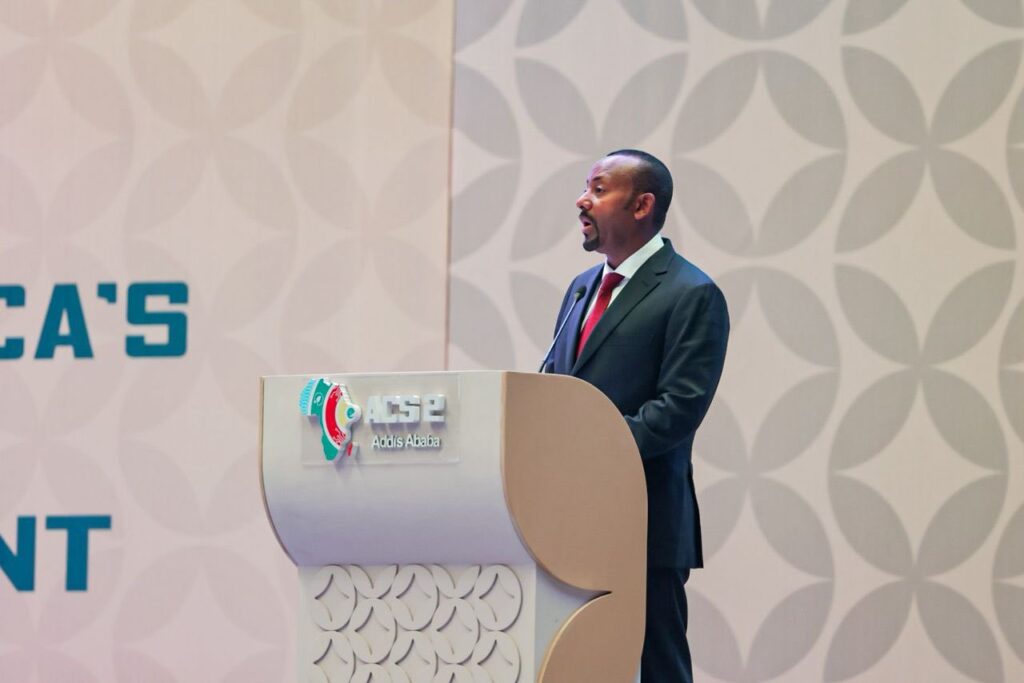
African leaders have announced a plan to mobilise US$50 billion annually to fund climate solutions across the continent, unveiling two new financing and innovation bodies at the close of the Second Africa Climate Summit (ACS2) in Addis Ababa.
The summit, held 8–10 September 2025, concluded with the launch of the African Climate Facility and the Africa Climate Innovation Compact, initiatives intended to generate 1,000 African-led climate solutions by 2030.
Ethiopian Prime Minister Abiy Ahmed, who hosted the gathering, said the measures aim to give Africa the resources and authority to confront escalating climate challenges:
“This effort aims to propose 1,000 solutions to climate challenges by 2030 on a continent that contributes only 4% of global greenhouse gas emissions.”
Although Africa emits a small fraction of the world’s greenhouse gases, it is among the regions most vulnerable to climate impacts. Prolonged droughts in the Horn of Africa, destructive floods in West and Central Africa, and increasing heatwaves are threatening food security and economic stability. Scientists note that Africa is warming faster than the global average.
According to the African Union, the continent requires about US $1.3 trillion every year to finance comprehensive adaptation and mitigation measures, far beyond current funding levels.
The $50 billion annual target follows a pattern of ambitious pledges. At the first Africa Climate Summit in 2023, leaders announced nearly US $26 billion in climate investment commitments, but tracking actual disbursement has proven difficult. Analysts say the details of the new funding timelines for mobilisation, the balance between public and private investment, and the mix of grants versus loans remain unclear.
Observers are also watching whether the African Climate Facility will offer more predictable and accessible financing than existing mechanisms. The Addis summit’s stated goal was to enable the continent to “speak with one voice” at the COP30 climate conference in Brazil this November, but delegates acknowledged the risk of pledges going unfulfilled without clear enforcement measures.
From aid to investment, leaders at ACS2 emphasised a shift in approach from aid dependency to climate investment, highlighting Africa’s potential as a source of solutions rather than merely a victim of global emissions. The Africa Climate Innovation Compact is designed to unite governments, research institutions, private investors, and local communities to foster technology and policy responses grounded in African realities.
The new commitment comes amid turbulence in international climate politics, including the United States’ withdrawal from the Paris Climate Accord, which has raised concerns about the reliability of global funding for developing regions. African leaders argue that predictable and substantial finance is critical if they are to meet their nationally determined contributions under the Paris framework and avoid escalating humanitarian and economic losses.


